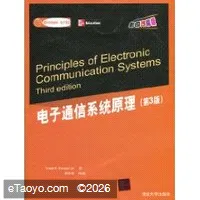
内容简介
《电子通信系统原理(第3版)(影印改编版)》是关于通信系统的经典著作,全面覆盖了各种主要的电子通信系统。全书采用丰富的插图和浅显的语言描述最新的通信技术,避免了高深的数学公式,特别适合用作大学本科的通信系统的双语教材。《电子通信系统原理(第3版)(影印改编版)》采用国内流行的每一章介绍一种主要通信系统的方式,便于学生自学以及教学内容的讲授。《电子通信系统原理(第3版)(影印改编版)》共分14章,包括通信系统导论、多路复用、通信系统中的二进制传输、网络和局域网导论、传输线、天线与电波传播、因特网技术、微波通信、卫星通信、电信系统、光纤通信、蜂窝电话技术、无线技术、通信测试与测量等,最后还给出了部分习题的答案以及术语表。
《电子通信系统原理(第3版)(影印改编版)》可作为通信工程专业、电子信息工程专业、信息工程专业的本科生,以及通信与信息系统、信号与信息处理、电磁场与微波技术等专业研究生的教材。
编辑推荐
《电子通信系统原理(第3版)(影印改编版)》:
彩色数字图像处理
纳电子学基础
现代电子通信(第9版)
PIC18微控制器:体系结构、编程与接口设计(C语言与汇编语言版)
形态学图像分析:原理与应用(第2版)
超大规模集成电路互连线分析与综合
《电子通信系统原理(第3版)(影印改编版)》特色:
现代通信系统与数据通信和因特网相结合,反映了最新的发展方向;
通信系统的内容按照通信方式进行分类,符合国内大多数教材的通行做法;
专门用一章的篇幅讨论无线通信中的天线与电波传播,对学生理解实际通信系统有很大的帮助作用;
无线通信技术一章总结介绍了该技术的最新发展动向,包括无线局域网、篮牙、WiMAX、RFID、UWB等;
专门有一章介绍通信测试和测量技术,对学生走向工作有帮助。
目录
Preface
Chapter 1 Introduction to Electronic Communication 1
1-1 The Significance of Human Communication 3
1-2 Communication Systems 3
1-3 Types of Electronic Communication 6
1-4 Modulation and Multiplexing 8
1-5 The Electromagnetic Spectrum 12
1-6 Bandwidth 18
1-7 A Survey of Communication Applications 22
1-8 Careers in the Communication Industry 24
Chapter 2 Multiplexing and Demultiplexing 31
2-1 Multiplexing Principles 32
2-2 Frequency-Division Multiplexing 33
2-3 Time-Division Multiplexing 42
2-4 Pulse-Code Modulation 50
2-5 Duplexing 56
Chapter 3 The Transmission of Binary Data in Communication Systems 59
3-1 Digital Codes 60
3-2 Principles of Digital Transmission 63
3-3 Transmission Efficiency 68
3-4 Modem Concepts and Methods 74
3-5 Wideband Modula1:ion 88
3-6 Broadband Modem Techniques 97
3-7 Error Detection and Correction 104
3-8 Protocols 112
Chapter 4 Introduction to Networking and Local-Area Networks 121
4-1 Network Fundamentals 122
4-2 LAN Hardware 129
4-3 Ethernet LANs 137
4-4 Token-Ring LAN 148
Chapter 5 Transmission Lines 154
5-1 Transmission Line Basics 155
5-2 Standing Waves 168
5-3 Transmission Lines as Circuit Elements 177
5-4 The Smith Chart 182
Chapter 6 Antennas and Wave Propagation 196
6-1 Antenna Fundamentals 197
6-2 Common Antenna Types 205
6-3 Radio Wave Propagation 231
Chapter 7 Internet Technologies 248
7-1 Internet Applications 249
7-2 Internet Transmission Systems 252
7-3 Storage-Area Networks 267
7-4 Internet Security 270
Chapter 8 Microwave Communication 278
8-1 Microwave Concepts 279
8-2 Microwave Lines and Devices 285
8-3 Waveguides and Cavity Resonators 294
8-4 Microwave Semiconductor Diodes 306
8-5 Microwave Tubes 310
8-6 Microwave Antennas 315
8-7 Microwave Applications 332
Chapter 9 Satellite Communication 344
9-1 Satellite Orbits 345
9-2 Satellite Communication Systems 352
9-3 Satellite Subsystems 356
9-4 Ground Stations 362
9-5 Satellite Applications 369
9-6 Global Positioning System 373
Chapter 10 Telecommunication Systems 383
10-1 Telephones 384
10-2 Telephone System 399
10-3 Facsimile 406
10-4 Paging Systems 412
10-5 Internet Telephony 417
Chapter 11 Optical Communication 423
11-1 Optical Principles 424
11-2 Optical Communication Systems 428
11-3 Fiber-Optic Cables 433
11-4 Optical Transmitters and Receivers 443
11-5 Wavelength-Division Multiplexing 457
11-6 Passive Optical Networks 459
Chapter 12 Cell Phone Technologies 466
12-1 Cellular Telephone Systems 467
12-2 Advanced Mobile Phone System (AMPS) 472
12-3 Digital Cell Phone System 477
Chapter 13 Wireless Technologies 497
13-1 Wireless LAN 499
13-2 PANs and Bluetooth 503
13-3 ZigBee and Mesh Wireless Networks 505
13-4 WiMAX and Wireless Metropolitan- Area Networks 507
13-5 Infrared Wireless 509
13-6 Radio-Frequency Identification and Near-Field Communications 514
13-7 Ultrawideband Wireless 519
Chapter 14 Communication Tests and Measurements 526
14-1 Communication Test Equipment 527
14-2 Common Communication Tests 540
14-3 Troubleshooting Techniques 557
14-4 Electromagnetical Interference Testing 563
Answers to Selected Problems 572
Glossary 574
序言
This new third edition of Principles of Electronic Communication Systems is fully revisedand updated to make it one of the most current textbooks available on wireless,networking, and other communications technologies. Because the field of electroniccommunications changes so fast, it is a never-ending challenge to keep a textbook up todate. While principles do not change, their emphasis and relevance do as technologyevolves. Furthermore, students need not only a firm grounding in the fundamentals butalso an essential understanding of the real word components, circuits, equipment, andsystems in everyday use. This latest edition attempts to balance the principles with anoverview of the latest techniques.
One of the major goals of this latest revision is to increase the emphasis on thesystem level understanding of wireless, networking, and other communications tech-nologies. Because of the heavy integration of communications circuits today, the engi-neer and the technician now work more with printed circuit boards, modules, plug-incards, and equipment rather than component level circuits. As a result, older obsoletecircuits have been removed from this text and replaced with more integrated circuits andblock diagram level analysis. Modem communications engineers and technicians workwith specifications and standards and spend their time testing, measuring, installing, andtroubleshooting. This edition moves in that direction. Detailed circuit analysis is stillincluded in selected areas where it proves useful in understanding the concepts and issuesin current equipment.
文摘
插图:
The phase detector compares the phase of the incoming PAM sine wave to the VCOsine wave. If a phase error exists, the phase detector produces an output voltage whichis filtered to provide a
| ISBN | 7302223602,978730222 |
|---|---|
| 出版社 | 清华大学出版社 |
| 作者 | 弗伦泽尔(Louis E.Frenzel.Jr.) |
| 尺寸 | 16 |