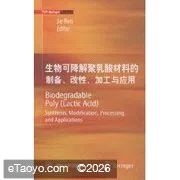
《生物可降解聚乳酸材料的制备、改性、加工与应用(国内版)》内容简介:随着环保技术的发展和石油等化石类资源的日益匮乏,人们对绿色环保材料的要求也愈益提高。《生物可降解聚乳酸材料的制备、改性、加工与应用(国内版)》从开发低毒、无污染和环境友好型生物质材料的角度入手,全面而详尽阐述了典型绿色材料聚乳酸的合成、改性、加工和应用的研究进展情况,包括聚乳酸的合成、改性技术,聚乳酸的注射、纺丝、吹膜、发泡等加工工艺,聚乳酸在包装材料、纤维与无纺布、工程塑料、一次性日用品、胶黏剂以及组织工程支架材料、药物缓释控制载体以及骨固定材料等方面的应用。
《生物可降解聚乳酸材料的制备、改性、加工与应用(国内版)》可供高校材料、化工、生物技术等专业的高年级本科生和研究生阅读,也可作为上述专业的高校教师以及科研院所、生产企业的研究人员和技术人员的参考材料。
编辑推荐
《生物可降解聚乳酸材料的制备、改性、加工与应用(国内版)》:Biodegradable Poly (Lactic Acid) Synthesis, Modification, Processing and Applications describes the preparation, modification, processing, and theresearch and applications of biodegradable poly (lactic acid)which belong to the biomedical and environment-friendly materials. Highly illustrated,the book introduces syatematically the synthesis, physical and chemicalmodifications, and the latest developments of research and applications of poly (lactic acid) in biomedical materials.
The book is intended for researchers and graduate students in the fields of materials science and engineering, polymer science and engineering,biomedicine, chemistry,environmental sciences, textile science and engineering, package materials, and soon. 作者简介
Dr. Jie Ren is a professor at the Institute of Nano and Bin-PolymericMaterials, School of Material Science and Engineering, Tonggji University,Shanghai, China. 目录
1 Introduction
2 Lactic Acid
2.1 Introduction
2.2 Properties
2.3 Preparation
2.3.1 Chemical Synthesis
2.3.2 Fermentation
2.4 Separation and Purification of LA
2.4.1 Esterification and Hydrolysis
2.4.2 Crystallization
2.4.3 Molecular Distillation
2.5 Application
2.5.1 Raw Materials of PLA
2.5.2 Additives in Foods
2.5.3 Applications in Cosmetics
2.5.4 Applications in Detergents
References
3 Synthesis and Manufacture of PLA
3.1 Direct Polycondensation of Lactic acid
3.2 Azeotropic Dehydrative Polycondensation of LA
3.3 Polycondensation Kinetics of LA
3.4 Ring-Opening Polymerization of Lactide
3.4.1 Cationic Ring-Opening Polymerization of Lactide
3.4.2 Anionic Ring-Opening Polymerization of Lactide
3.4.3 Coordination-Insertion Polymerization of Lactide
3.4.4 Enzymatic Ring-Opening Polymerization of Lactide
References
4 Modification of PLA
4.1 Copolymerization of PLA
4.1.1 Random and alternating copolymers of PLA
4.1.2 Block Copolymers of PLA
4.1.3 Multi-Block Copolymers of PLA
4.1.4 Graft or Branched Copolymers of PLA
4.1.5 Star-Shaped Copolymers of PLA
4.1.6 Dendritic Copolymers of PLA
4.2 PLA Blending
4.2.1 PLA/HA
4.2.2 PLA/PEG
4.2.3 PLA/PHB
4.2.4 PLLA/PDLA
4.2.5 PLLA and PDLLA/PCL
4.2.6 PLA/PBS
4.2.7 PLA/PHEE
4.2.8 PLA/PMMA
4.2.9 PLA/PVA
4.2.10 PLA/PBAT
4.3 Composites
4.4 Additives
4.4.1 Additives for PLA
4.4.2 PLA Crystallization Behavior and Nucleating Agents...
4.5 New Modifiers for PLA
4.5.1 Core-Shell Impact Modifiers
4.5.2 Nanocomposites
References
5 Processing of PLA
5.1 Injection :
5.1.1 PLA Injection Molding
5.1.2 Controlling Crystallinity in Injection Molded PLA
5.1.3 Mechanical Properties of Injection-Molded Poly(L-Lactic Acid)
5.1.4 Porous Lamellar Poly (L-Lactic Acid) Scaffolds Made by Conventional Injection Molding Process
5.1.5 Shear Controlled Orientation in Injection Molding of PLLA
5.2 Spinning
5.2.1 Melt Spinning of PLA
5.2.2 Dry Spinning of PLA
5.2.3 Wet Spinning of PLA
5.2.4 Dry-Jet-Wet Spinning of PLA
5.2.5 Dyeing of PLA Fibers
5.2.6 Electrospirming of PLA Fibers
5.3 Blowing
5.3.1 Properties for Packaging
5.3.2 Process of Blown Film
5.3.3 Modification of Blown Film
5.4 Foaming
5.4.1 Modification of PLA and Its Foam
5.4.2 Starch/PLLA Hybrid Foams
5.4.3 PLA/PBAT Blend Foams
5.4.4 PLA Nanocomposite Foams
References
6 Application in the Field of Commodity and Industry Product
6.1 Packaging Materials
6.2 Fiber and Nonwoven
6.2.1 PLA Fibers
6.2.2 Application of PLA Fibers
6.3 Engineering Plastic
6.4 Disposable Ware
6.4.1 What Is the Difference Between Biodegradable and Compostable?
6.4.2 About PLA for Disposable Use
6.4.3 Commercial PLA Disposable Ware
6.5 Biodegradable Hot Melt Adhesive Based on PLA and Other Biodegradable Polymer
6.5.1 Biodegradable PLA and/or PCL Based Biodegradable HMAS
6.5.2 PHBV and PEA Based on Biodegradable HMAS
6.5.3 Natural Polymer Based on Biodegradable HMAS
Reference
7 Application in the Field of Biomedical Materials
7.1 Tissue Engineering Scaffold
7.1.1 Design Principles of Tisssue Engineering Scaffold
7.1.2 PLA Materials and Modification for Tissue Eningeering Scaffold Application
7.1.3 Surface Hydrophilicity Modifications
7.1.4 Biomimetic ECM Modification
7.1.5 PLA/Apatite Composite
7.1.6 Preparation of Tissue Engineering Scaffolds
7.1.7 Thermally Induced Phase Separation
7.1.8 Solvent Casting/Particulate Leaching
7.1.9 Gas Foaming
7.2 Controllable Drug Delivery Based on PLA
7.2.1 Introduction to Drug Delivery Based on PLA
7.2.2 Science of Controllable Drug Delivery
7.3 Other Biomedical Appliances
7.3.1 PLA Used For Surgical Sutures
7.3.2 Ideal Filler for Soft Tissue Augmentation
7.3.3 Mesh Insertion for Groin Hernia Repair
Reference
8 Standard and Test Methods
8.1 Biodegradation of PLA
8.1.1 Definition of Biodegradation
8.1.2 Factors Affecting the Biodegradation Behaviour of PLA
8.1.3 Abiotic Degradation
8.1.4 Biotic Degradation
8.2 Biodegradation Standards and Certification Systems
8.2.1 Biodegradation Standards
8.2.2 Different Certification Systems .
8.3 Introduction to Some Test Methods
8.3.1 Visual Observation
8.3.2 Gravimetry
8.3.3 Enzyme Assays
8.3.4 Plate Tests
8.3.5 Respiration Tests
8.3.6 Controlled Composting Test
Reference
Index 文摘
版权页:
插图:
(1)Poortoughness——PLA is a very brittle material with less than 10% elongation at break.Although its tensile strength and elastic modulus are comparable to poly(ethyleneterephthalate) (PET), the poor toughness limits its use in the applications thatneed plastic deformation at higher stress levels screws and fracture fixationplates.
(2) Slow degradation mte——-PLA degrades through the hydrolysis of backboneester groups and the degradation rate depends on the PLA crystallinity, molecularweight, molecular weight distribution, morphology, water diffusion rate into thepolymer, and the stereoisomeric content. The degradation rate is often consideredto be an important selection criterion for biomedical applications. The slowdegradation rate leads to a long life time in vivo, which could be up to years insome cases. There have been reports of a second surgery almost 3 years afterimplantation to remove a PLA-based implant. The slow degradation rate is aserious problem with respect to disposal of consumer commodities as well.
(3) Hydrophobicity——PLA is relatively hydrophobic, with a static water contactangle of approximately 80 This results in low cell affinity, and can elicit aninflammatory response from the living host upon direct contact with biologicalfluids.
(4) Lack of reactive side-chain groups——PLA is chemically inert with noreactive side-chain groups making its surface and bulk modifications a challengingtask. The successful implementation of PLA in consumer and biomedicalapplications relies not only on mechanical properties being better than orcomparable to conventional plastics, but also on controlled surface properties(such as hydrophilicity, toughness, and reactive functionalities). PLA has been bulkmodified mainly to improve toughness and degradation rate. The surfacemodification of PLA has been attempted to control hydrophilicity, toughness,and to introduce reactive groups. The toughness improvement is a crucial necessityfor many consumer applications, while the improvements in hydrophilicity andintroduction of reactive groups are beneficial to biomedical applications. Theimprovements in degradation rate could be important in both consumer andbiomedical applications.
| ISBN | 9787302236016 |
|---|---|
| 出版社 | 清华大学出版社 |
| 作者 | 任杰 |
| 尺寸 | 16 |