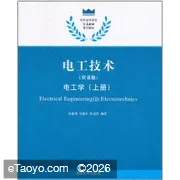
《电工技术(双语版):电工学(上册)》内容包括电路的基本概念和电路元件、电路分析基础、正弦交流电路、三相电路、电路的暂态分析、磁路和变压器、电动机和电气控制技术,共8章。《电工技术(双语版):电工学(上册)》主要内容使用中文编写,其中专业术语附有英文对照、书中的例题、习题等内容使用英文编写。《电工技术(双语版):电工学(上册)》的姊妹篇《电子技术》内容包括基本半导体器件、基本放大电路、集成运算放大器、功率电子电路、数字电路基础、组合逻辑电路、触发器与时序逻辑电路、数模和模数转换技术、波形的产生与整形和EDA技术概述共10章,宜与《电工技术(双语版):电工学(上册)》配套使用。
《电工技术(双语版):电工学(上册)》概念描述清晰易懂;内容新颖实用,贴近工程实际。可作为高等院校本科非电类各专业(机械、材料、工程力学、核、测量、机电一体化、经贸管理、运输、土木建筑等)相关课程的教材,特别适合开设双语电工学课程的院校使用;也可作为职业大学、成人教育大学、电视大学和网络教育等同类专业的教材;还可以作为工程技术人员的学习参考资料。
编辑推荐
《电工技术(双语版):电工学(上册)》:中外合作办学双语教学系列教材 目录
第1章 电路的基本概念和电路元件
1.1 电路和电路的模型
1.1.1 电路
1.1.2 电路模型
1.2 电路的基本物理量及参考方向
1.2.1 电流
1.2.2 电位
1.2.3 电压
1.2.4 电动势
1.2.5 电功率
1.3 欧姆定律
1.4 电路的理想元件
1.4.1 理想无源元件
1.4.2 理想电源元件
1.5 电路的实际元件
1.5.1 实际无源元件
1.5.2 实际电源模型
1.6 电路的工作状态
1.6.1 有载状态
1.6.2 开路
1.6.3 短路
1.7 Practical Perspective:Electrical Circuits
Summary
Problems
第2章 电路分析基础
2.1 基尔霍夫定律
2.1.1 基尔霍夫电流定律
2.1.2 基尔霍夫电压定律
2.2 电阻的串联与分压电路
2.2.1 电阻的串联
2.2.2 分压电路
2.3 电阻的并联与分流电路
2.3.1 电阻的并联
2.3.2 分流电路
2.4 支路电流法
2.5 叠加原理
2.6 戴维南定理与诺顿定理
2.6.1 戴维南定理
2.6.2 诺顿定理
2.7 电源的等效变换
2.8 非线性电阻电路
2.8.1 线性电阻
2.8.2 非线性电阻
2.8.3 非线性电阻电路
2.9 Practical Perspective:Digital-to-analog ResistiveLadder
Summary
Problems
第3章 正弦交流电路
3.1 正弦量的三要素
3.2 正弦量的相量表示法
3.3 单一参数的正弦交流电路
3.4 简单正弦交流电路的计算
3.5 阻抗的串联、并联与混联
3.6 t弦交流电路中的谐振
3.6.1 串联谐振
3.6.2 并联谐振
3.7 功率因数的提高
……
第4章 三相电路
第5章 电路的暂态分析
第6章 磁路和变压器
第7章 电动机
第8章电气控制技术 文摘
版权页:
插图:
The fact that the frequency difference is only 10 Hz reveals that there was agreement on the general frequency range that should be used for power generation and distribution.History suggests that the question of frequency selection was originally focused on that frequency that would not exhibit ficker in the incandescent lamps available in those days.Technically,however,they are based on this criterion.Another important factor in the early design stages was the effect of frequency on the size of transformers,which play a major role in power generation and distribution.Working through the fundamental equations for transformer design,it is found that the size of a transformer is inversely proportional to frequency.The result is that transformers operation at 5 0 Hz must be larger(on a purely mathematical basis about 1 7%larger)
than those operating at 60 Hz.The transformers are designed for the international market where they can operate on 50 Hz or 60 Hz and are designed around the 50 Hz frequency.On the flip side of the coin,however,higher frequencies result in increased concerns about arcing,increased losses in the transformers core due to eddy current and hysteresis losses,and skin effect phenomena.Somewhere in the discussion it must be considered that the fact that 60 Hz is an exact multiple of 60 seconds in a minute and 60 minutes in an hour.Since accurate timing is such a critical part of the technological design,was this a significant motive in the final choice? There is also the question about whether the 5 0 Hz is a result of the close affinity of this value to the metric system.Keep in mind that powers of 1 0 are all powerful in the metric system,with 100 cm in a meter,100℃the boiling point of water,and SO on.
| ISBN | 730223275X,978730223 |
|---|---|
| 出版社 | 清华大学出版社 |
| 作者 | 汤春明 |
| 尺寸 | 16 |